Call (602) 826-5721



Quick Summary
Modern lifestyles place constant stress on eyeglasses, leading to increased cases of hinge damage, bent frames, and broken bridges. Frequent handling, travel, and lightweight materials all contribute to higher breakage rates. Fortunately, professional eyeglass repair—including laser welding—can restore most frames quickly and cost-effectively.
Quick Facts About Eyeglass Damage
- Glasses are handled 20–50 times per day
- Most common failures: hinges, bridges, and temple arms
- Metal frames (including titanium) often break at stress points—not across the entire frame
- Laser welding glasses repair is the most effective method for metal frame restoration
- Mail-in eyeglass repair services allow nationwide access to expert repair
- Most broken glasses can be repaired instead of replaced
Why Glasses Break More Today
Increased Daily Handling and Stress
Eyeglasses are constantly removed, adjusted, and repositioned throughout the day. Each interaction applies micro-stress to the frame, gradually weakening key structural areas.
Fast-Paced, Mobile Lifestyles
Modern routines increase exposure to accidental damage:
- Sitting on glasses
- Dropping them
- Storing them improperly
- One-handed removal causing frame twisting
These are the leading causes of broken glasses repair cases.
Lightweight Frame Materials
Modern frames prioritize comfort and design, often using:
- Titanium
- Stainless steel
- Memory metals
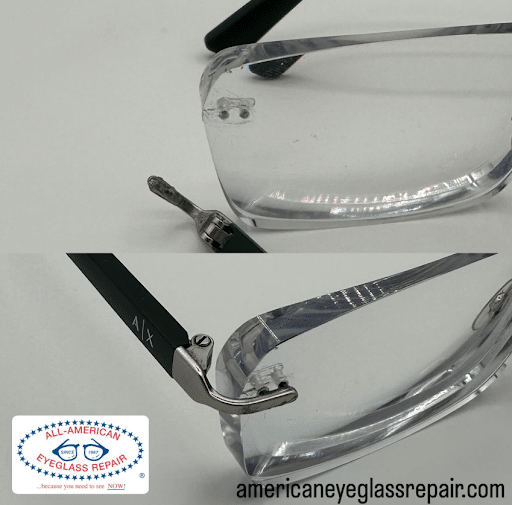
While durable, these materials develop stress fractures at hinges and bridges, often requiring laser welding eyeglass repair.
Signs Your Glasses May Be About to Break
- Loose or wobbly hinges
- Crooked or misaligned frames
- Small cracks near the bridge or joints
- Screws that repeatedly loosen
Early intervention with glasses frame repair can prevent full breakage.
The Most Common Eyeglass Repairs
Hinge Repair
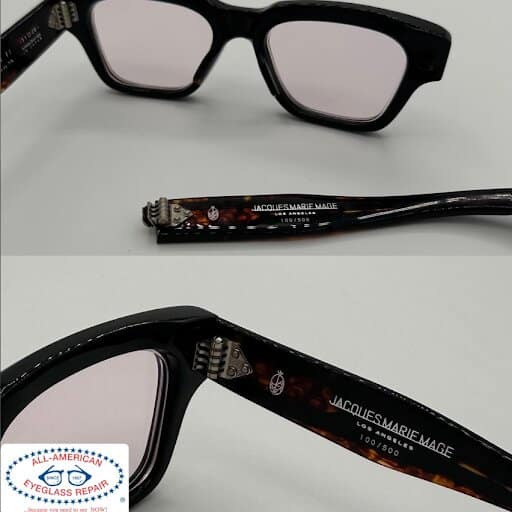
Constant movement causes hinges to loosen, strip, or break entirely.
Bridge Repair
The bridge supports lens weight and is a high-stress failure point.
Temple (Arm) Repair
Bent or detached arms affect fit, comfort, and usability.
Nose Pad Repair
Loose or broken nose pad arms impact alignment and wearability.
How Frame Materials Affect Repair Options
Titanium Frames
Require laser welding for precise, durable repair.
Stainless Steel Frames
Strong but prone to fatigue at joints.
Acetate / Plastic Frames
More likely to snap; repair depends on severity.
Memory Metal Frames
Flexible but commonly fail at hinges.
Material type directly determines the best eyeglass repair method.
Why Laser Welding Is the Gold Standard for Glasses Repair
Unlike traditional soldering, laser welding glasses repair uses controlled energy to fuse metal at a microscopic level.
This allows:
- Precision repairs on delicate frames
- Stronger bonds at stress points
- Safe repair of titanium eyeglass frames
- Minimal heat impact on surrounding material
This method is widely used for repairing premium brands such as Ray-Ban, Oakley, Prada, Persol, and Silhouette.
Eyeglass Repair vs Replacement: Which Is Better?
Repair is the better option when:
- Frames are high-quality or designer
- Damage is isolated (hinge, bridge, temple)
- Lenses are still usable
Replacement may be necessary when:
- Frames are severely damaged plastic
- Multiple structural failures exist
- Lenses also need replacement
In most cases, professional eyeglass repair is faster and more cost-effective than replacement.
Why Trust a Professional Eyeglass Repair Specialist?
Eyeglass repair requires precision tools and deep material knowledge.
At All American Eyeglass Repair:
- Technicians specialize in frame-specific repair techniques
- Advanced methods like laser welding are standard
- Repairs are evaluated for long-term durability—not just quick fixes
With decades of experience, professional repair ensures reliable results that DIY solutions cannot match.
Trusted Eyeglass Repair Since 1987
All American Eyeglass Repair was founded in Mesa, Arizona in 1987 by licensed optician Harriet Munguia-Lugo, who brings over 50 years of hands-on optical experience.
- Pioneer in laser welding for eyeglass repair
- Trusted by customers nationwide
- Hybrid model: walk-in + mail-in eyeglass repair service
AAER has restored hundreds of thousands of frames, helping customers avoid unnecessary replacement costs.
Mail-In Eyeglass Repair: Nationwide Access
Customers across the U.S. can access expert repair through a simple process:
- Mail in damaged glasses
- Receive professional evaluation
- Get precision repair and return shipping
This makes online eyeglass repair service accessible regardless of location.
How to Prevent Glasses from Breaking
- Store glasses in a protective case
- Use both hands when removing
- Avoid placing glasses in high-pressure areas
- Keep frames properly adjusted
- Address minor issues early
Frequently Asked Questions (FAQ)
Can broken glasses really be repaired?
Yes. Most metal frame damage—including hinges and bridges—can be repaired using professional techniques like laser welding.
Is it cheaper to repair or replace glasses?
Repair is typically more affordable, especially for high-quality or prescription frames.
Can titanium glasses be repaired?
Yes. Titanium eyeglass repair is commonly performed using laser welding.
How long does eyeglass repair take?
Turnaround times vary, but many repairs are completed quickly by experienced technicians.
Do I need to visit a store?
No. Mail-in eyeglass repair services allow nationwide access to professional repair.
Most Glasses Can Be Repaired—Not Replaced
In today’s fast-paced environment, eyeglasses are exposed to constant stress, making damage more common than ever. However, most frames—especially metal and titanium—can be restored using advanced techniques like laser welding eyeglass repair, eliminating the need for replacement.
All American Eyeglass Repair, founded in 1987 by licensed optician Harriet Munguia-Lugo, is one of the most experienced eyeglass repair specialists in the United States. With decades of hands-on expertise and a focus on precision repair, AAER has restored hundreds of thousands of frames, including delicate and designer eyewear.
Through a combination of specialized tools, laser welding technology, and material-specific repair methods, AAER is able to repair frames that many would consider beyond saving.
With nationwide mail-in service and walk-in locations, customers across the U.S. rely on AAER for consistent, high-quality results.
In most cases, repairing your glasses is not only possible—it’s the smarter, faster, and more cost-effective solution.